
What Challenges Do Fiber Media Converter Manufacturers Face During Deployment
Reliable data transmission has become essential for industrial networks, enterprise communication systems, and smart infrastructure projects. As organizations expand their fiber networks, fiber media converters provide an effective solution for connecting different types of communication interfaces. However, improper planning during deployment can lead to compatibility issues, performance limitations, and unnecessary maintenance costs. Working with experienced fiber media converter manufacturers helps businesses design stable and efficient network solutions from the beginning.
Fiber media converter deployment involves more than simply converting electrical signals into optical signals. Network designers must consider transmission distance, fiber type, bandwidth requirements, environmental conditions, and future scalability. By understanding common design challenges, companies can make better decisions when selecting equipment and building reliable fiber communication systems.
Selecting the Right Fiber Media Converter for Network Requirements
One of the most common challenges in fiber media converter deployment is selecting equipment that matches the actual application environment. Different network projects have different requirements regarding transmission speed, fiber distance, connector types, and operating conditions. Choosing a converter without considering these factors may result in reduced performance or compatibility problems.
For instance, an office network may only need 100M conversion, while a factory backbone requires gigabit fiber conversion.
Professional fiber media converter manufacturers help customers evaluate network requirements before selecting products. Factors such as data rate, optical wavelength, fiber mode, and power supply options should be carefully reviewed to ensure the converter can operate effectively within the existing network architecture.
Another important consideration is future expansion. A network solution should not only meet current needs but also support future upgrades. Selecting products with flexible interfaces and advanced transmission capabilities can reduce replacement costs when network demands increase.
Managing Compatibility Between Fiber and Ethernet Systems
Fiber media converters are widely used because they bridge the connection between traditional copper Ethernet equipment and fiber-optic infrastructure. However, ensuring compatibility between different devices remains a major design challenge.
Network engineers need to verify whether the converter matches the connected switches, routers, and optical modules. Differences in transmission standards, fiber wavelengths, and interface specifications may affect communication stability. Without proper compatibility testing, businesses may experience packet loss, unstable connections, or unexpected network interruptions.
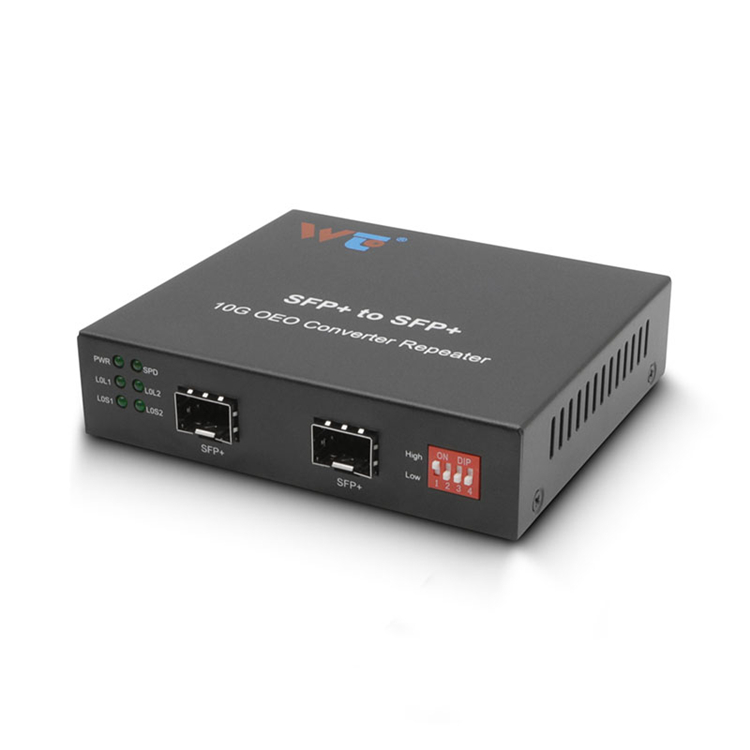
A reliable fiber media converter solution should support seamless signal conversion while maintaining network performance. For example, Wintop's WT-F2F-WSFP 10G SFP+ Wavelength Converter (fiber-Ethernet media converter) is designed for high-speed optical communication applications. This desktop-type converter supports SFP+ wavelength conversion and provides transparent transport with very low delay, making it suitable for networks requiring efficient data transmission.
The product also supports hot plugging, allowing easier maintenance and replacement without significantly affecting system operation. This feature is particularly valuable for businesses that require continuous network availability.
Addressing Signal Quality and Transmission Stability Challenges
Maintaining signal quality over long-distance fiber connections is another important challenge. Optical signals may experience attenuation, distortion, or timing issues during transmission, especially in complex network environments.
To address these challenges, advanced fiber media converters often include signal regeneration technologies. The WT Fiber Ethernet Media Converter WT-F2F-WSFP features a 3R function, including Regeneration, Reshaping, and Retiming. These functions help restore signal quality by improving waveform stability and timing accuracy.
Jumbo Frame support is another valuable feature for high-performance networks. Large data packets can improve transmission efficiency in applications that require significant data exchange. By supporting Jumbo Frames, fiber media converters can help optimize network performance for specific communication scenarios.
When selecting equipment, businesses should consider not only basic conversion functions but also advanced features that improve long-term reliability. Experienced fiber media converter manufacturers understand these technical requirements and develop products that meet the demands of modern communication networks.
Improving Deployment Efficiency and Long-Term Network Management
A successful fiber media converter deployment requires careful planning beyond product selection. Installation methods, environmental conditions, and maintenance strategies all influence network performance.
For industrial and outdoor-related applications, equipment durability is especially important. Temperature changes, electromagnetic interference, and continuous operation can affect communication equipment over time. Selecting converters designed with reliable components and stable performance helps reduce unexpected downtime.
Additionally, simplified installation and maintenance can improve operational efficiency. Features such as hot plugging allow technicians to replace or configure equipment more conveniently. Clear product specifications and professional technical support from suppliers also help reduce deployment difficulties.
Businesses should work with suppliers that can provide complete solutions rather than individual products. Experienced manufacturers can offer guidance on system design, compatibility testing, and application optimization. This support is valuable for projects involving large-scale communication networks where reliability is a priority.
Building Reliable Fiber Networks with Wintop’s Professional Solutions
Fiber media converter deployment requires a balance between compatibility, performance, reliability, and future scalability. Companies that carefully evaluate network requirements and cooperate with experienced suppliers can avoid many common design challenges.
At Wintop, we are a trusted network equipment supplier and national high-tech enterprise specializing in the research, development, production, and sales of optical modules and switches. As one of the professional fiber media converter manufacturers, we provide reliable fiber-optic communication products designed for industrial and enterprise applications.
Our WT Fiber Ethernet Media Converter WT-F2F-WSFP 10G SFP+ Wavelength Converter supports Jumbo Frame, hot plugging, transparent transport, very low delay transmission, and advanced 3R signal processing functions. These features help customers build stable and efficient fiber communication networks for demanding environments.
With extensive experience in optical networking technology, more than 60 core technology patents, and successful deployment experience in over 1,000 smart substation projects across 40+ countries, Wintop continues to deliver dependable communication solutions. Contact us today to explore professional fiber media converter solutions and strengthen your next-generation network infrastructure.