
SFP Optical Transceiver Architecture Explained
In modern fiber-optic communication systems, the SFP optical transceiver is a critical component that enables fast and stable data transmission between networking devices. At Wintop, we approach optical modules from a system integration perspective, and many users often want a clear understanding of what actually happens inside an SFP module. The architecture is not overly complex when broken down into functional blocks, but each part plays an important role in ensuring signal quality, transmission distance, and device compatibility.
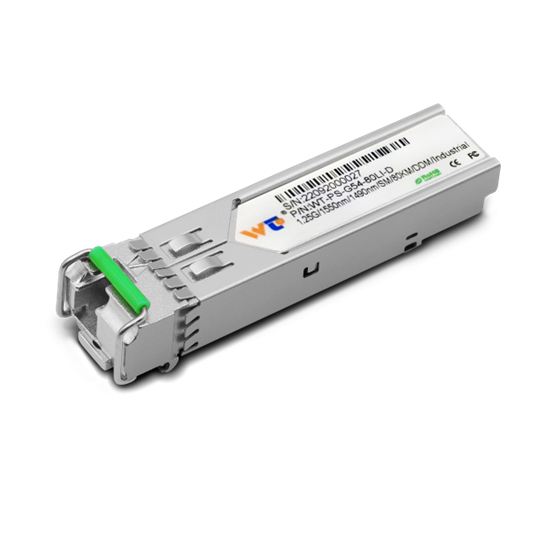
Core Architecture of an SFP Optical Transceiver
An SFP optical transceiver is a compact, hot-pluggable module that integrates both electrical and optical functions into a single package. Internally, it is generally composed of the transmit section, the receive section, signal processing circuitry, and a digital monitoring interface. These parts work together continuously whenever data is transmitted or received, allowing seamless conversion between electrical signals from the host device and optical signals in the fiber network.
TOSA: Optical Transmit Sub-Assembly
The transmit section of the module is known as the TOSA, or Transmit Optical Sub-Assembly. Its primary function is to convert electrical signals into optical signals that can travel through fiber optic cables. Inside the TOSA, a laser diode,such as a VCSEL or DFB light source,generates light pulses that represent digital data. These light signals are then precisely aligned and coupled into the fiber through optical components designed to minimize loss. A monitoring photodiode is often included to ensure output power remains stable, while temperature and power control mechanisms help maintain consistent performance. The quality of the TOSA directly influences transmission distance and signal stability, making it one of the most critical parts of the module.
ROSA: Optical Receive Sub-Assembly
On the receiving side, the ROSA or Receive Optical Sub-Assembly is responsible for converting incoming optical signals back into electrical signals that the host system can process. When light enters the module, it is first captured by a photodiode, which generates a very weak electrical current in response. This signal is then amplified by a transimpedance amplifier to a level suitable for digital interpretation. Optical focusing elements help improve signal capture efficiency, especially in long-distance transmission scenarios. The sensitivity and noise performance of the ROSA determine how well the module can handle weak or degraded signals, which is essential for maintaining reliable communication links.
Signal Processing and Electrical Interface
Between the transmit and receive sections lies the signal processing circuitry, which ensures that all data signals are properly conditioned before being sent or received. The laser driver regulates the electrical input to the laser diode to ensure stable optical output, while limiting amplifiers help clean and restore incoming electrical signals. In higher-speed modules, additional functions such as equalization and clock and data recovery are used to reduce jitter and signal distortion. This section acts as the control bridge that keeps both optical and electrical domains aligned and stable during operation.
Control and Monitoring Interface
An important part of the SFP optical transceiver architecture is its digital monitoring system, which allows the host device to communicate with the module through an I2C interface. This system provides real-time information such as optical output power, received signal strength, operating temperature, supply voltage, and diagnostic status. This monitoring capability allows network operators to evaluate module health and detect potential issues early, which helps improve overall network reliability and maintenance efficiency.
Integrated System Design Considerations
The overall architecture of an SFP optical transceiver is designed to balance size, power consumption, and performance. Each internal component must be carefully optimized to reduce signal loss, maintain thermal stability, and ensure compatibility with different networking equipment. Even small variations in alignment or electrical control can affect signal quality, which is why precise engineering and manufacturing consistency are essential in optical module design.
Conclusion
The architecture of an SFP optical transceiver is built around a clear functional structure that includes transmission, reception, signal processing, and monitoring. Each section plays a specific role in ensuring stable and efficient fiber optic communication. At Wintop, we focus on delivering SFP optical transceiver solutions that combine reliable performance, consistent compatibility, and strict quality control. If you are looking for dependable optical modules for networking applications, Wintop provides practical solutions designed to meet real-world deployment needs.