
Integration of SFP to RJ45 Adapters in Industrial Automation
Industrial automation systems rely on stable and efficient communication between controllers, sensors, switches, and monitoring platforms. As industrial networks continue to evolve, many facilities need to connect modern fiber-enabled equipment with existing copper Ethernet infrastructure. This is where an SFP to RJ45 adapter becomes a practical solution.
An SFP to RJ45 adapter allows network devices equipped with SFP ports to communicate through standard RJ45 Ethernet cabling. This flexibility helps manufacturers, system integrators, and plant operators expand or upgrade their networks without replacing large amounts of existing infrastructure. The result is a cost-effective approach to maintaining connectivity across industrial environments.
Benefits of Using SFP to RJ45 Adapters in Automation Systems
Industrial facilities often contain a mix of legacy equipment and newer networking technologies. An SFP to RJ45 adapter bridges this gap by supporting copper Ethernet connections through SFP interfaces.
One important advantage is simplified network expansion. Existing Cat5e, Cat6, or Cat6a cabling can continue to be used while connecting to switches and industrial networking devices equipped with SFP ports. This reduces installation complexity and minimizes downtime during upgrades.
Another benefit is flexibility. Many industrial networks require varying transmission speeds depending on the application. Modern SFP to RJ45 adapters support Gigabit Ethernet and, in some cases, multi-gigabit data rates, allowing network designers to adapt to changing operational requirements.
Key Considerations for Industrial Deployment
When selecting an SFP to RJ45 adapter for industrial automation, compatibility should be carefully evaluated. Network switches, routers, and industrial Ethernet devices may have specific requirements for transceiver modules. Industry users frequently emphasize the importance of verifying compatibility before deployment to ensure reliable operation.
Environmental conditions are another important factor. Industrial settings often involve temperature fluctuations, vibration, and electromagnetic interference. Choosing adapters with robust construction and appropriate operating specifications helps maintain network stability. Industrial-grade transceivers are commonly designed to operate across wider temperature ranges for demanding environments.
Power consumption and thermal management should also be considered, especially in high-density networking applications. Proper airflow and equipment placement can contribute to long-term reliability.
Wintop SFP to RJ45 Solutions for Industrial Connectivity
At Wintop, we provide SFP to RJ45 adapter solutions designed to support reliable Ethernet connectivity across industrial and enterprise networks. Our WT-SFP-T module supports 10/100/1000BASE-T operation, offers transmission distances up to 100 meters over copper cabling, and features a compact hot-pluggable design.
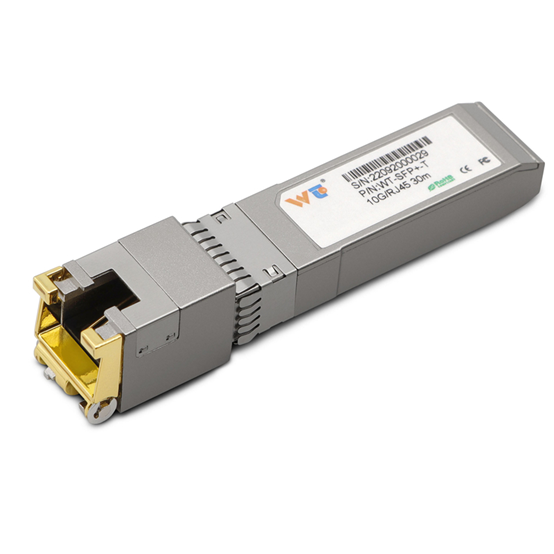
For higher-bandwidth applications, our WT-SFP+-T module supports 10GBASE-T, 5GBASE-T, 2.5GBASE-T, and 1000BASE-T connections, making it suitable for industrial systems that require increased network capacity while maintaining RJ45 infrastructure.
Conclusion
The integration of an SFP to RJ45 adapter provides industrial automation networks with greater flexibility, scalability, and investment protection. By enabling seamless communication between SFP-based equipment and copper Ethernet infrastructure, these adapters simplify upgrades and support efficient network expansion.
Wintop offers a range of SFP to RJ45 adapter solutions designed for dependable performance, broad compatibility, and straightforward deployment. Contact Wintop today to explore reliable transceiver solutions that support your industrial networking requirements.