
Standards and Protocols for SFP Copper Transceivers
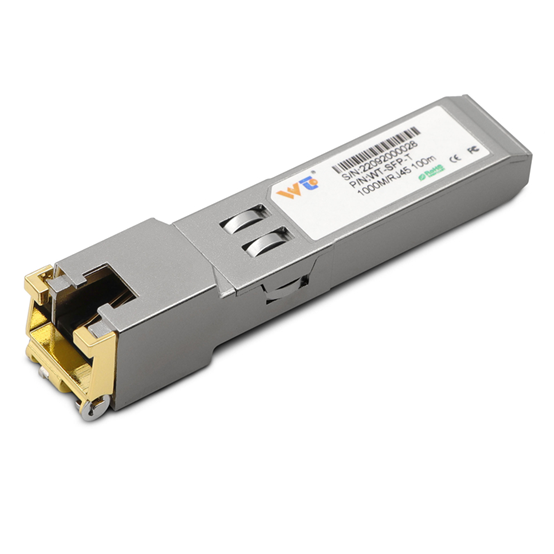
SFP copper transceivers are widely used to extend Ethernet connectivity through standard twisted pair cabling while operating within an SFP port on switches and routers. An SFP copper transceiver enables electrical signal conversion between the host system and RJ45 based Ethernet networks, making it a practical solution for short-range data transmission in enterprise and industrial environments. At Wintop, we design our solutions based on strict protocol compliance to ensure stable performance and broad compatibility.
IEEE Ethernet Standards Supporting Operation
The operation of an SFP copper transceiver is grounded in Ethernet standards defined by IEEE. The most common standard is 1000BASE T under IEEE 802.3ab, which supports Gigabit Ethernet transmission over Category 5e or higher copper cabling up to 100 meters. This standard uses four twisted copper pairs to achieve full duplex communication and ensures reliable data exchange through advanced signal encoding and noise handling methods.
In addition to Gigabit support, many modern modules also operate across multiple Ethernet speeds, including 10, 100, and 1000BASE T modes. This flexibility allows network administrators to integrate new hardware into existing infrastructures without replacing cabling systems.
Auto Negotiation and Link Protocol Behavior
A key protocol feature in SFP copper transceivers is auto negotiation. This process allows two connected devices to automatically exchange information about supported speeds and duplex modes before establishing a link. Once the negotiation is complete, the devices select the highest common performance level.
This mechanism improves deployment efficiency and reduces configuration errors. It also allows the module to adapt dynamically when connected to legacy network equipment or mixed vendor environments, ensuring stable communication without manual adjustment.
Host Interface and SFP MSA Compliance
On the host side, SFP copper transceivers must comply with the SFP Multi Source Agreement standards. This ensures mechanical fit, electrical compatibility, and hot plug capability across different vendors and networking devices.
Inside the module, protocol conversion occurs between the SFP interface and internal Ethernet physical layer processing. Depending on design architecture, the module may use interfaces such as SerDes or SGMII to bridge the host system with copper-based Ethernet signaling. This conversion process ensures that data transmitted through the SFP slot is properly translated into standard Ethernet frames on the RJ45 port.
Physical Layer Processing and Signal Handling
Unlike optical modules, SFP copper transceivers include a full Ethernet physical layer chipset. This allows them to manage signal equalization, echo cancellation, and timing recovery required for reliable copper transmission. Because electrical signaling over twisted pair cabling is more sensitive to interference, the module actively processes and stabilizes the signal to maintain data integrity.
This additional processing also results in higher power consumption compared to optical modules, which is an important consideration in dense networking environments where heat management is critical.
Conclusion
SFP copper transceivers rely on a combination of IEEE Ethernet standards, auto negotiation protocols, and SFP MSA compliance to ensure reliable network communication. Their ability to convert SFP host signals into copper-based Ethernet makes them a flexible and widely used solution in modern network infrastructure.
At Wintop, we provide SFP copper transceivers designed with strict adherence to industry standards, ensuring compatibility, stability, and consistent performance across a wide range of networking applications. Contact Wintop to explore dependable connectivity solutions tailored to your network requirements.