
Why RJ45 Transceivers Are Important in Hybrid Ethernet Networks
In modern networking environments, hybrid Ethernet networks are becoming increasingly common as enterprises balance copper and fiber infrastructure. In this context, the RJ45 transceiver plays a practical role in bridging traditional twisted-pair cabling with modular SFP-based systems. We at Wintop focus on delivering reliable RJ45 transceiver solutions that help network designers maintain flexibility while optimizing infrastructure reuse and operational efficiency.
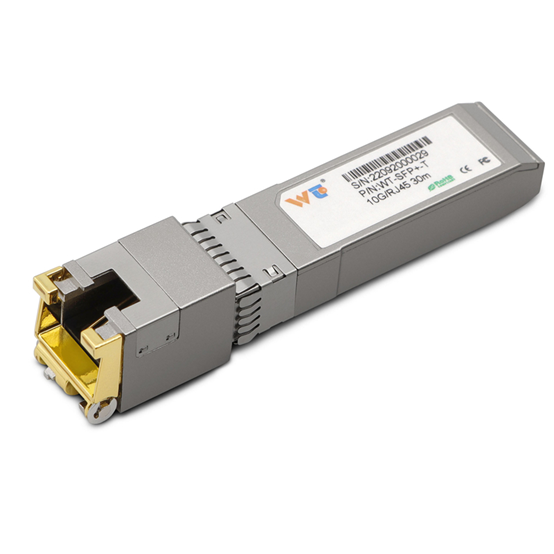
Understanding RJ45 Transceivers in Hybrid Networks
An RJ45 transceiver, often referred to as a copper SFP module, is a hot-pluggable device that enables Ethernet over copper cables through an SFP or SFP+ slot. Instead of relying on optical transmission, it uses electrical signaling over Cat5e, Cat6, or Cat6a cabling to transmit data efficiently within short distances, typically up to 100 meters .
In hybrid Ethernet networks, this functionality is essential because it allows a single switching platform to support both fiber and copper connections. This flexibility reduces the need for separate hardware types and simplifies network design.
Key Role in Network Flexibility and Compatibility
One of the main advantages of RJ45 transceivers is their ability to extend the usability of SFP-based switches. Many enterprise switches prioritize fiber SFP ports for scalability, but real-world environments still rely heavily on RJ45 endpoints such as PCs, IP cameras, and access points.
By using RJ45 transceivers, network engineers can:
Support legacy copper infrastructure without replacing existing cabling
Enable mixed media deployment within the same switch
Reduce the need for fixed RJ45 ports on networking devices
This makes them especially valuable in phased network upgrades, where full fiber migration is not immediately feasible.
Performance Considerations in Hybrid Environments
While RJ45 transceivers provide flexibility, they also introduce specific technical considerations. Compared to fiber modules, copper-based transceivers typically consume more power and generate more heat due to the complex digital signal processing required for electrical transmission over twisted-pair cabling .
However, for short-range connections in access-layer networks, they remain a practical choice. They support auto-negotiation and can integrate seamlessly into mixed-speed environments, including 1G and 10G Ethernet depending on the module type.
Use Cases in Enterprise and Data Center Networks
RJ45 transceivers are widely used in several hybrid networking scenarios:
Access layer connectivity for office devices and endpoints
Temporary or flexible network expansions where fiber deployment is not possible
Data center edge connections between fiber backbones and copper-based equipment
Industrial environments where rugged copper cabling is preferred
Their ability to bridge different transmission media makes them a key component in maintaining interoperability across network layers.
Why RJ45 Transceivers Matter for Hybrid Architecture
Hybrid Ethernet architecture is driven by the need to balance performance, cost, and deployment flexibility. RJ45 transceivers help achieve this balance by allowing organizations to reuse existing copper infrastructure while still leveraging modern modular switch systems.
They also simplify inventory management because a single switch platform can support multiple media types through interchangeable modules. This reduces complexity in large-scale deployments and improves scalability planning.
Conclusion
RJ45 transceivers are an essential component in hybrid Ethernet networks because they enable seamless integration between copper-based infrastructure and modular fiber systems. Their ability to extend RJ45 connectivity through SFP ports provides practical flexibility for evolving network environments while maintaining compatibility with existing cabling.
At Wintop, we design and supply RJ45 transceiver solutions that support stable performance, broad compatibility, and efficient network integration. Our goal is to help customers build adaptable hybrid networks that can scale with future demands while making the most of their current infrastructure.