
Industrial Use Cases of Ethernet to Fiber Media Converters
In modern industrial networking, we rely on stable data transmission between devices that are often spread across long distances or installed in electrically noisy environments. An Ethernet to fiber media converter plays a key role in this setup by bridging copper-based Ethernet networks with fiber optic links. At Wintop, we work with these solutions to help industrial users extend network reach, improve signal reliability, and maintain stable communication across complex infrastructures.
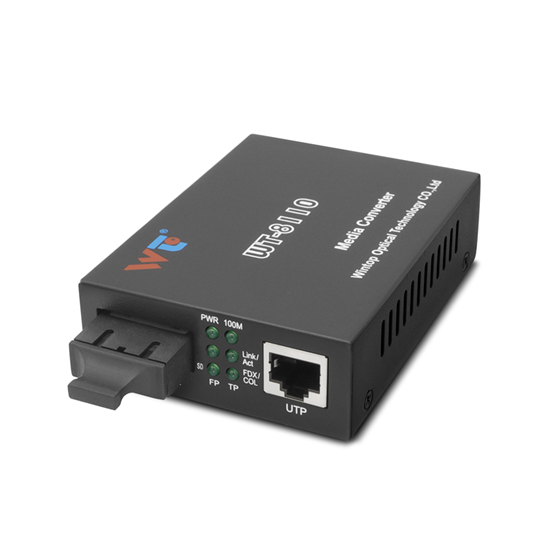
What an Ethernet to Fiber Media Converter Does
An Ethernet to fiber media converter is a physical layer device that converts electrical Ethernet signals into optical signals and vice versa. This allows standard RJ45-based equipment such as PLCs, industrial switches, IP cameras, and controllers to communicate over fiber optic cables.
Fiber transmission is especially valuable because it offers strong resistance to electromagnetic interference, supports longer transmission distances, and maintains stable throughput even in harsh operating environments. These characteristics make it essential in industrial applications where copper cabling alone is not sufficient.
Factory Automation and Production Lines
In factory environments, machinery and control systems often operate across large production areas. Ethernet to fiber media converters help connect PLC cabinets, robotic systems, and control centers without signal degradation.
We frequently see their use in production line communication networks where stable real-time data exchange is required. Fiber links reduce interference from heavy machinery, motors, and welding equipment, ensuring that control signals remain consistent and reliable throughout the operation.
Intelligent Transportation and Infrastructure
Transportation systems such as rail networks, tunnels, and highways depend on uninterrupted communication between distributed monitoring devices. Ethernet to fiber media converters are widely used to connect traffic cameras, signaling systems, and control rooms over long distances.
In these environments, fiber optic transmission reduces vulnerability to electrical surges and environmental noise. It also enables centralized monitoring systems to receive real-time data from multiple remote endpoints, improving operational coordination.
Energy, Utilities, and Substation Networks
Power stations, renewable energy sites, and electrical substations require secure and interference-free communication networks. Ethernet to fiber media converters are used to link SCADA systems, sensors, and protection relays across facilities.
Because fiber is immune to electromagnetic interference, it is especially suitable for high-voltage environments. This helps ensure stable monitoring of critical infrastructure such as grid performance, transformer status, and energy distribution systems.
Security and Surveillance Systems
Industrial campuses, warehouses, and outdoor facilities often deploy large-scale surveillance networks. Ethernet to fiber media converters allow IP cameras and access control systems to transmit video data over long distances without signal loss.
This is particularly useful when cameras are installed far from control rooms. Fiber connectivity ensures high-quality video transmission and reduces latency, supporting continuous monitoring and security management.
Conclusion
Ethernet to fiber media converters are essential components in industrial networking, enabling reliable communication across long distances and challenging environments. From factory automation to energy infrastructure and transportation systems, they ensure stable data transmission where copper networks fall short.
At Wintop, we focus on delivering industrial networking solutions designed for real-world operational demands. Our Ethernet to fiber media converter solutions are built to support stable performance, flexible deployment, and long-term reliability in demanding industrial scenarios.
Wintop provides practical, application-focused connectivity solutions to help industrial networks operate with greater stability and efficiency.